EdTech · Language learning
Lingio
Lingio believes that learning should be a pleasurable experience that motivates people to practice and learn more quickly. That is why they employ artificial intelligence, gamification, and coaching to produce outstanding results for their customers and their employees.
2015
Founded in Sweden
€3.7m
Funding round led by BackingMinds (2022)
7
Tilde Loop engineers embedded with Lingio
At a glance
- Sector
- Language learning
- Partnership
- Since autumn 2022
- Engagement
- Embedded engineering team
- Stack
- Svelte · SvelteKit
Lingio was founded in 2015 in reaction to the large number of foreigners moving to Sweden. Three former Spotify and EA Games colleagues were eager to contribute and assist newcomers in more swiftly assimilating into Swedish society and the work market.
The three founders sought to make learning and growth easier and more accessible for everyone, particularly those who work in fast-paced, underrepresented industries. Cleaning services, transportation, hospitality, construction, and home care are just a few examples. They identified a market gap for training and development for these target groups. Lingio, a language-learning product for working professionals, was created by combining their game and product skills.
In order to make sure that the content is interesting, current, and informative, the Lingio’s team of technological professionals closely collaborates with language teachers, educators, and vocational teachers.
Several clients quickly inquired whether Lingio might make learning skills as enjoyable and effective as their language courses. Therefore Lingio expanded their product offering into skills learning and in 2023 they even released an AI Course Creator where customers themselves can generate courses based on existing documents.
In order to grow internationally, Lingio closed a round of funding in 2022 of about 3.7 million euros, which was led by BackingMinds.
Our collaboration with Lingio started in the fall of 2022. The first goal of joining four of our software engineers and one software engineer in test with Lingio‘s backend team was to assist them with the migration of an existing web application to new technology (Svelte/SvelteKit), which will increase the app’s speed and eliminate a lot of unnecessary legacy code.
Why Svelte?
Svelte, like React and Vue, is a JavaScript framework/library. Svelte has created its own, unique method of allowing developers to build exactly what they need and want. It is sometimes referred to as a compiler because of its novel approach.
React and Vue use a virtual DOM in the browser, which can result in performance issues. Svelte, on the other hand, does not use a virtual DOM, instead compiling code into tiny, pure Vanilla JS. As a result, the code runs much faster from the start, making the app much lighter and easier to use. This is the first and most noticeable difference that Svelte has made, and this is the reason why this technology was chosen for the Lingio app.
Along with Svelte, we adapted SvelteKit – a UI framework that makes use of a compiler to enable developers to create components with astonishingly low overhead in the browser using languages like HTML, CSS, and JavaScript.
Our collaboration with Lingio
When we started working on the project, the app and whole solution were coded in JavaScript, React.js, and a custom store solution that used Redux Saga. In communication with the client, the decision was to gradually move to Svelte and SvelteKit.
The first step was to write a solution for Elearning courses as a web-component using Svelte. After the initial implementation, both the client and us were pleased with the solution, so we started coding a bigger challenge, migrating the app itself to SvelteKit.
We found SvelteKit really useful and up to the game for what we needed. Framework that has a built in store solution, an intuitive and easy to use routing system, and on top of all that, a very small bundle size. All of that helped us build a new app from scratch that has a smaller bundle size and is thus faster than the initial app.
We helped and continue to help the client move all their frontend applications to Svelte/SvelteKit. By doing so, the app itself should be faster and thus more UX friendly. In the process of migration, the client decided to redesign screens so they are more UX compliant and we were part of that process.
Current screen design
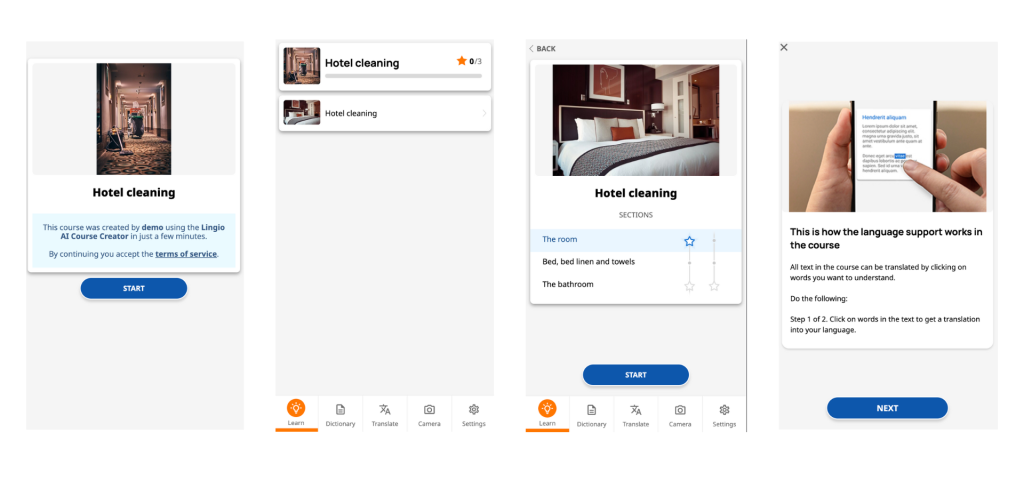
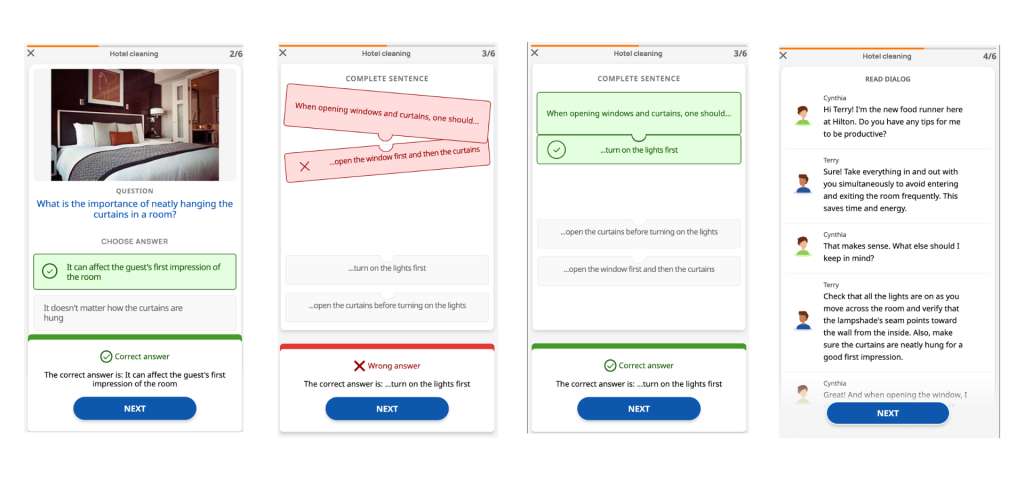
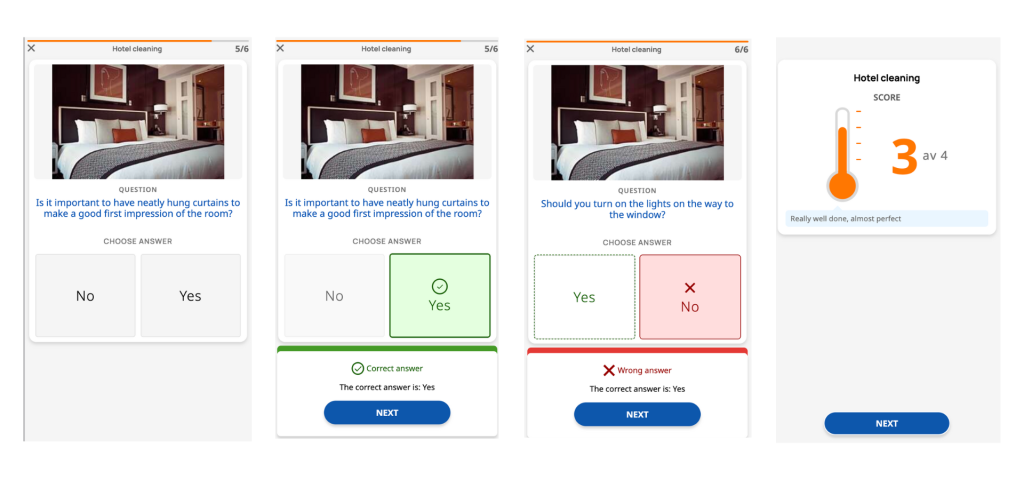
This migration and everything that is planned for us to achieve in this collaboration will ensure that Lingio achieves its current and future business goals easier and faster. We are extremely pleased to collaborate with an experienced, ambitious, and promising team like Lingio and to be a part of their story. Particularly when we consider the end users, for whom the application we are developing greatly helps them to swiftly acclimatise to their new environment and the labour market.